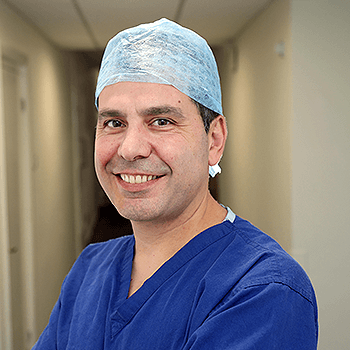
Medically Reviewed By: Mr Panos Papikinos
Repair of hydrocele is an operation that removes or repairs a fluid filled sac surrounding the testicle, called the hydrocele, to prevent further fluid accumulating.
A hydrocele is caused by the accumulation of fluid in the sac surrounding the testicle, known as the tunica vaginalis. Common causes include:
Congenital factors - in newborns, hydroceles may occur due to incomplete closure of the processus vaginalis during foetal development.
Injury or trauma - physical damage to the scrotum can lead to fluid buildup.
Infections or inflammation - conditions like epididymitis or orchitis can trigger hydrocele formation.
Systemic diseases - rarely, hydroceles may be associated with kidney or liver disorders that affect fluid balance.
Post-surgical complications - hydroceles may develop after procedures involving the scrotum or groin.
Hydroceles are classified into two main types:
Communicating hydrocele - occurs when the processus vaginalis remains open, allowing fluid from the abdominal cavity to flow into the scrotum. This type is common in infants and may fluctuate in size throughout the day.
Non-communicating hydrocele - results from fluid trapped in the scrotal sac due to the closure of the processus vaginalis. It typically remains constant in size and is more common in adults.
Pre-operative ultrasound scans are a crucial step in ensuring accurate diagnosis and effective planning for hydrocele repair surgery. These scans provide detailed imaging of the scrotal area, allowing healthcare providers to:
Confirm the diagnosis - differentiate hydroceles from other conditions, such as inguinal hernias, testicular tumours, or varicoceles.
Assess the size and location - determine the extent of the hydrocele and its impact on surrounding structures.
Identify complications - detect any associated issues, such as infections or inflammation, that may influence surgical planning.
Guide surgical approach - help surgeons decide on the most appropriate technique, whether it’s open hydrocelectomy, Lord’s plication, or Jaboulay procedure.
Hydrocele repair surgery is performed to remove or repair a fluid-filled sac surrounding the testicle, known as a hydrocele. The procedure aims to prevent further fluid accumulation and alleviate discomfort or swelling.
Recent studies have highlighted alternative approaches, such as aspiration and sclerotherapy, which may be considered for patients at high surgical risk. However, hydrocelectomy remains the gold standard for long-term resolution due to its lower recurrence rates1.
The surgeon begins by making a small incision in the scrotum to access the hydrocele. The fluid within the sac is drained, and the sac is either turned inside out and stitched to prevent re-accumulation or removed entirely, depending on the surgeon’s assessment.
Preparation steps include:
Medical evaluation - your doctor will review your medical history and perform a physical examination.
Medication review - inform your healthcare provider about any medications or supplements you’re taking, especially blood thinners.
Fasting - avoid eating or drinking for at least six hours before surgery if general anaesthesia is planned.
Pre-operative tests - blood tests, urine tests, and imaging may be conducted to ensure fitness for surgery.
Clothing - bring tight-fitting underwear for post-operative support to reduce swelling.
Hydrocele repair surgery involves removing or repairing the fluid-filled sac. Techniques include:
Open hydrocelectomy - the surgeon makes an incision in the scrotum to drain the fluid and either remove or reshape the sac. It has a high success rate, long-lasting results, and low recurrence risk.
Lord’s plication - the sac is folded (plication) and stitched to reduce its size without complete removal. It is a minimally invasive open surgical technique with a shorter recovery time.
Jaboulay procedure - the sac is turned inside out and stitched to prevent the reaccumulation of fluid. It is an open surgical approach effective for larger hydroceles.
Laparoscopic hydrocelectomy - a minimally invasive approach using small incisions and a camera-guided procedure. It offers reduced post-operative pain and a faster recovery.
Immediate recovery - you may experience swelling, bruising, and mild discomfort in the scrotal area.
Pain management - painkillers or anti-inflammatory medications will be prescribed.
Wound care - keep the surgical site clean and dry, and follow your doctor’s instructions for dressing changes.
Activity restrictions - avoid strenuous activities, heavy lifting, and sexual intercourse for at least two weeks.
Follow-up - attend scheduled appointments to monitor healing and address any concerns.
Recovery typically takes seven to fourteen days. During this period, you should avoid strenuous activities, heavy lifting, and sexual intercourse until discomfort subsides.
Minimally invasive approaches, such as laparoscopic repair, may offer faster recovery times and reduced post-operative pain. However, traditional open repair remains widely used and effective.
Recovery typically follows this timeline:
Week 1 - swelling and discomfort are most pronounced and rest is essential.
Week 2 - symptoms begin to subside, and light activities may be resumed.
Week 3-4 - most patients experience significant improvement and can return to normal routines.
Beyond Week 4 - full recovery is expected, though individual timelines may vary.
The hydrocele repair surgery cost will depend on the specific type of surgery to remove your scrotal lump.
These guide prices are an estimate of costs and you will receive a formal quotation price following your consultation with one of our surgeons. This formal quote for your hydrocele repair surgery will be valid for 60 days and includes unlimited aftercare.
We have a number of finance options available for our self-pay patients. These include All-inclusive Total Care where a single one-off payment at a pre-agreed price delivers direct access to all the treatment they need for complete reassurance, pay as you go and, interest-free medical finance plans.
Hydrocele repair surgery costs are covered by most medical insurance policies. We advise that you get written authorisation from your insurance provider before commencing your surgery. Here’s a detailed write-up based on your request:
Most patients experience mild discomfort, which is manageable with prescribed painkillers.
Recurrence is rare, especially with open hydrocelectomy or Jaboulay procedures.
Driving is usually safe after 1 to 2 weeks, once discomfort has subsided.
Risks include infection, bleeding, or swelling, but these are uncommon with proper care.
Most insurance policies cover hydrocele repair, but written authorization is recommended.
1 https://link.springer.com/article/10.1007/s00464-023-10143-5
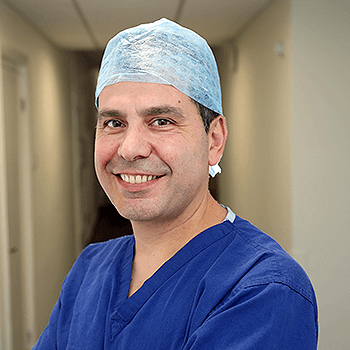
Mr Panos Papikinos
Urology
Mr Panos Papikinos is a Consultant Urologist Surgeon in Surrey
View Profile

Spread the cost over a term you choose, with fixed monthly payments that fit your budget, so you’re always in control.
Find out more
Don't put your health on hold because of finances. We offer a range of ways to pay, so you can find what works for you and focus on getting better.
Find out more
Already covered? Let your insurance do the work. Our simple referral process means less paperwork and a faster path to treatment.
Find out moreAn epididymal cyst is a harmless fluid-filled growth on a man's testicle. Get expert epididymal cyst removal surgery at Ramsay Health Care. Book today.
Surgery that involves cutting both the tubes (vas) that carry sperm from the testicles.

Ramsay Health Care UK has achieved the highest Net Promoter Scores (NPS) among multi-site healthcare provider groups in the 2025 patient experience benchmarks, published by Cemplicity.


We have recently updated how we communicate with our patients. Alongside traditional letters, we now make greater use of digital communication, such as email and text messages, so that important information reaches you in the most effective way.
The information, including but not limited to, text, graphics, images and other material, contained on this website is for educational purposes only and not intended to be a substitute for medical advice, diagnosis or treatment. Always seek the advice of your physician or other qualified health care provider with any questions you may have regarding a medical condition or treatment.
No warranty or guarantee is made that the information contained on this website is complete or accurate in every respect. The testimonials, statements, and opinions presented on our website are applicable to the individuals depicted. Results will vary and may not be representative of the experience of others. Prior patient results are only provided as examples of what may be achievable. Individual results will vary and no guarantee is stated or implied by any photo use or any statement on this website.
Ramsay is a trusted provider of plastic or reconstructive surgery treatments as a part of our wrap-around holistic patient care. Our personal, friendly and professional team are here to support you throughout to ensure the best possible care. All procedures we perform are clinically justified.
*Acceptance is subject to status. Terms and conditions apply. Ramsay Health Care UK Operations Limited is authorised and regulated by the Financial Conduct authority under FRN 702886. Ramsay Healthcare UK Operations is acting as a credit broker to Chrysalis Finance Limited.
Ramsay Health Care UK is not currently recruiting for any roles based outside of England. If you are interested in applying for a role with Ramsay Health Care UK, please note that all available positions are advertised exclusively on our official website: https://www.ramsayhealth.co.uk/careers. Be cautious of individuals or organisations that approach you directly for remotely-based roles. Always verify the authenticity of the job offer and be careful with whom you share your personal information. For more information and advice on employment fraud, please visit: https://www.ramsayhealth.co.uk/careers/recruitment-fraud